

Calcium lignosulfonate (40–65) is a specifically defined food-additive material evaluated by the Joint FAO/WHO Expert Committee on Food Additives (JECFA) in 2008. The “40–65” designation refers to its specified weight-average molecular-weight range of 40,000–65,000. It must not be treated as a generic specification for all calcium lignosulfonates sold for agriculture, feed, concrete, ceramics or other industrial uses.
This page explains the chemical characterization and limits reported in the original JECFA assessment. The numerical data below are published regulatory-assessment data for calcium lignosulfonate (40–65), not Green Agrochem product specifications, supplier-recommended dosage or proof that another grade is equivalent.
Primary sources and scope
- FAO/JECFA Chemical and Technical Assessment: Calcium Lignosulfonate (40–65), 69th meeting, 2008
- WHO JECFA database record for Calcium Lignosulfonate (40–65)
- FAO Combined Compendium entry and specification-monograph links
JECFA evaluated this material as a carrier for encapsulated fat-soluble vitamins and carotenoids in water-based foods. That regulatory purpose is narrower than the many industrial functions associated with the broader lignosulfonate category.
What the 40–65 designation means
According to the 2008 FAO/JECFA assessment, the number identifies a weight-average molecular-weight specification of 40,000–65,000. The assessment also reported that more than 90% of polymer constituents were within a much broader molecular-weight range of 1,000–250,000.
These values characterize the evaluated additive and its specified distribution. They do not establish the molecular weight of ordinary calcium lignosulfonate grades. Commercial lignosulfonates are polydisperse materials, and analytical method and sample preparation matter when comparing molecular-weight data.
Chemical structure and identification
The evaluated material is derived from sulfite pulping of softwood. Its lignin framework contains aromatic units related to coniferyl, p-coumaryl and sinapyl alcohol, with coniferyl-derived units described as predominant. Sulfonate groups improve water compatibility, while calcium acts as the named counter-ion.
JECFA’s chemical and technical assessment used several identity and characterization tools:
- weight-average molecular weight and distribution;
- degree of sulfonation;
- ultraviolet spectroscopy for aromatic/phenyl features;
- infrared spectroscopy for characteristic sulfonate-related bands;
- solubility, pH and calcium analysis.
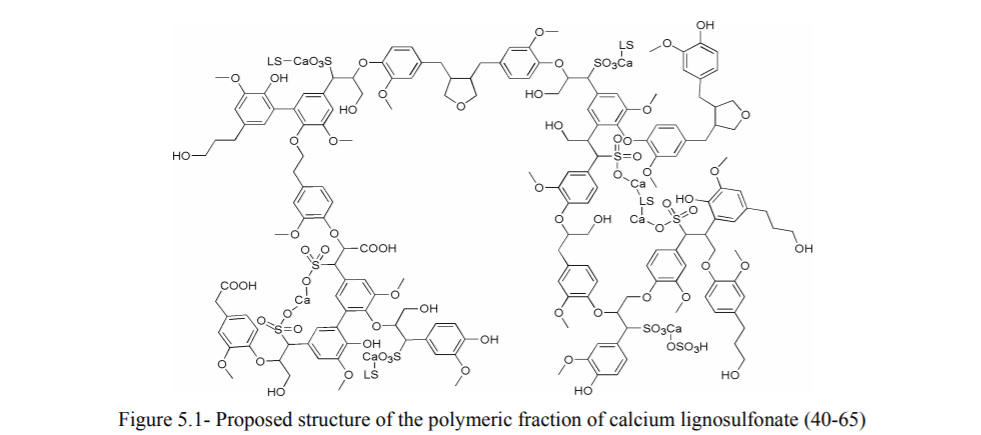
Published characterization data
| Reported item | Published value or observation | Evidence/status | How to interpret it |
|---|---|---|---|
| Weight-average molecular weight | 40,000–65,000 | JECFA specification identity for calcium lignosulfonate (40–65) | Defines the evaluated additive, not generic commercial calcium lignosulfonate |
| Polymer distribution | More than 90% between 1,000 and 250,000 | Reported in the 2008 assessment | Shows broad polydispersity despite the named weight-average range |
| Calcium | 5.0% maximum | Published specification limit for the evaluated material | Not a Green Agrochem product limit unless an exact-grade current document states it |
| IR bands | Approximately 1210–1220, 1037 and 655 cm⁻¹ | Reported characterization features | Identification evidence; not an application-performance result |
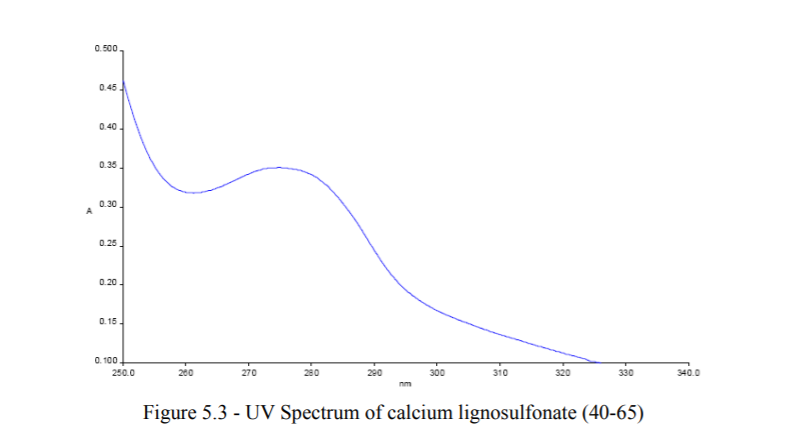
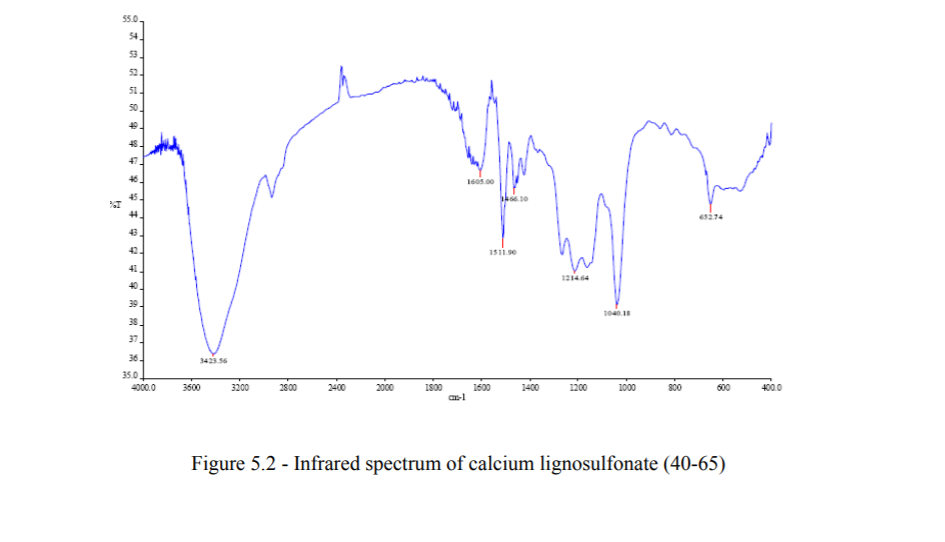
Impurities and specification limits in the JECFA material
The assessment discusses wood-derived monosaccharides, sulfite residues and trace elements as relevant impurity considerations. The following values belong specifically to the published monograph/assessment context:
| Parameter | Published value | Data type | Scope limitation |
|---|---|---|---|
| Reducing sugars | 5% maximum on the dried basis | JECFA specification limit | Applies to calcium lignosulfonate (40–65), not every calcium lignosulfonate grade |
| Sulfite | 0.5% maximum on the dried basis | JECFA specification limit | Use the method and monograph for compliance interpretation |
| Loss on drying | 8.0% maximum | JECFA specification limit | Not equivalent to a supplier’s moisture limit without matching method/basis |
| Total ash | 14.0% maximum | JECFA specification limit | Specific to the evaluated additive |
| Arsenic | 1 mg/kg maximum | JECFA specification limit | Regulatory assessment value; confirm current jurisdiction and exact-grade compliance |
| Lead | 2 mg/kg maximum | JECFA specification limit | Regulatory assessment value; not a blanket market claim |
Single-sample sugar profile reported by the sponsor
The assessment records one sponsor-provided sample analysis. This is a reported single-sample result, not a guaranteed composition:
| Sugar | Reported result | Evidence/status |
|---|---|---|
| Mannose | 2.2% | One sponsor-provided sample in the JECFA assessment |
| Xylose | 1.1% | One sponsor-provided sample |
| Galactose | 0.6% | One sponsor-provided sample |
| Glucose | 0.4% | One sponsor-provided sample |
| Arabinose | 0.3% | One sponsor-provided sample |
| Rhamnose | 0.1% | One sponsor-provided sample |
The values should not be copied into a commercial TDS. A buyer evaluating an offered grade should use its current specification and recent batch COA.
Regulatory interpretation
The WHO JECFA database records an evaluation year of 2008 and an acceptable daily intake (ADI) of 0–20 mg/kg body weight for the evaluated calcium lignosulfonate (40–65). This statement must remain attached to the defined additive and JECFA evaluation. It is not a dosage recommendation, nutrient inclusion level, feed authorization, or safety approval for every lignosulfonate product and every jurisdiction.
Food, feed and agricultural uses require product- and market-specific review. Confirm identity, purity, manufacturing process, intended function, exposure and the applicable current rules before making a compliance claim.
Feed-additive characterisation is a different dossier
The JECFA data above apply only to calcium lignosulfonate (40-65). Lignosulphonates used as feed binders were characterised separately by the EFSA FEEDAP Panel. It described them as amorphous branched lignin polymers made of sulphonated, covalently linked phenylpropane monomers from sulphite pulping. Calcium, sodium and magnesium lignosulphonate were assessed together as one additive. The Panel found it safe for chickens for fattening, laying hens, pigs for fattening and cattle for fattening at up to 10,000 mg/kg complete feed, and effective as a pellet binder from 7,500 mg/kg (EFSA Journal 2015; 13(7):4160, doi:10.2903/j.efsa.2015.4160; updated in 2020, doi:10.2903/j.efsa.2020.6000). Feed grades and dosing are covered by the group’s feed division: lignosulfonate in animal feed.
How commercial buyers should use this information
- Determine whether the offered product is actually represented as calcium lignosulfonate (40–65) or another grade.
- Do not transfer JECFA limits into a supplier specification without exact identity and documentary evidence.
- Request the current TDS, COA and SDS for the offered grade.
- Compare units, dried/as-supplied basis and test methods.
- Obtain application- and jurisdiction-specific compliance documentation.
- Use separate application trials to determine technical performance.
Related resources
For broader context, see the Lignosulfonate Knowledge Center. For documentation enquiries about an offered commercial grade, contact the technical team; the historical JECFA figures on this page are not a claim of product equivalence.
- Calcium Lignosulfonate in Fertilizer Formulations — agricultural formulation and trial guidance, without treating JECFA values as product specifications.
- Calcium Lignosulfonate Technical Overview — neutral product-category information.
- Industrial Calcium Lignosulfonate — industrial purchasing and documentation route.
Frequently asked questions
Does “40–65” mean 40–65% calcium lignosulfonate?
No. It refers to a weight-average molecular-weight range of 40,000–65,000 for the JECFA-defined material.
Can these impurity limits be used for an industrial grade?
Not automatically. They are specification values for a defined food-additive material. Use the exact industrial grade’s current TDS/COA and applicable requirements.
Are the sugar percentages guaranteed?
No. The individual sugar values were reported for one sponsor-provided sample; they are not universal composition limits.
Do the JECFA findings approve every food or feed use?
No. The evaluation concerns a defined material and intended use. Current product identity, jurisdiction and application-specific authorization must be confirmed.
