
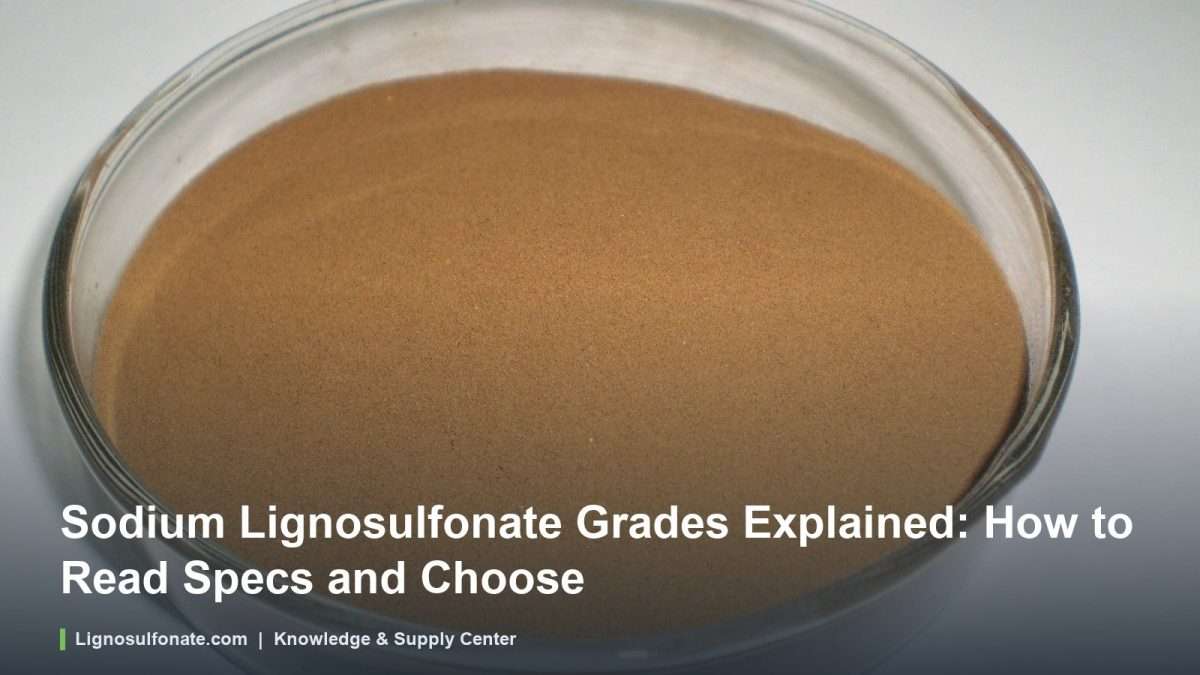
Sodium lignosulfonate is sold in many grades, and the names alone say little. Two products called “sodium lignosulfonate” can differ in purity, sugar, insoluble matter, pH and calcium content, and those differences decide whether a grade works in your process. This guide explains each line of a technical data sheet (TDS), shows how our grades group, and suggests where to start for common applications.
All figures below are typical values from the Rev. 2.0 TDS of each grade, available in our sodium lignosulfonate document library and liquid lignosulfonate library. The batch COA gives the measured values for each shipment.
What Each Specification Line Means
| Parameter | What it tells you | Why it matters | Range across our grades |
|---|---|---|---|
| Lignosulphonate content | The active part of the product | Higher content means more dispersing or binding power per kilogram | 50% min (liquid grades) to 95% min, dry basis (Super Grade) |
| Reducing sugar | Wood sugars left from pulping | Sugars retard cement setting, darken colour and attract moisture | 2% max (Food Grade) and 3.5% max (Light Color) up to around 20% (Ceramics Binder liquid) |
| Water-insoluble matter | Fibre, sand and other undissolved solids | Affects filters, spray nozzles and dispersion quality | 0.5% max (Dispersant, Emulsifier, Super) up to 2.5% max (several liquid grades) |
| pH | Acidity or alkalinity of the solution | Compatibility with the rest of the formulation | 4 – 6 (Grade Three) up to 9.0 – 13.0 (Grade Two, High Solubility) |
| Calcium & magnesium | Hardness ions carried in the product | Can cause precipitation or scaling in sensitive systems | Free of Ca/Mg (Free Ca, Mg Grade); 0.5% max for most grades |
| Water reducing capacity | Water reduction in a standard concrete test | A quick indicator for construction use | 5% min (Grades Two, Three, High Solubility) to 8% min (Grade One, Construction and others) |
| Dry matter / solids | How much of the product is not water | Compare prices on the same basis | 95% min for powders; 45% min for most liquids; 40% ± 2% for the retarder liquid |
How the Grades Group
General purpose
| Grade | pH | Insolubles | Reducing sugar | What sets it apart |
|---|---|---|---|---|
| Grade One (GAC-NaLS-1) | 7.0 – 9.5 | 1.5% max | 7% max | Main all-round grade; 55% min lignosulphonate (dry basis) |
| Grade Two (GAC-NaLS-2) | 9.0 – 13.0 | 2% max | 7% max | Alkaline |
| Grade Three (GAC-NaLS-3) | 4 – 6 | 1.5% max | 7% max | Acidic |
| High Solubility (GAC-NaLS-HS) | 9.0 – 13.0 | 100% water solubility | 7% max | Complete dissolution |
| Plus Grade (GAC-NaLS-PLUS) | 8.0 – 10.5 | 1% max | 7% max | Lower insolubles than Grade One |
Construction
| Grade | Key values | Use |
|---|---|---|
| Construction Grade | 65% min lignosulphonate, 1% max insolubles, water reducing capacity 8% min | Concrete water reducer |
| Retarder Powder Grade | pH 9.0 – 11.0 | Set retarder for ready-mix and mortar |
| Retarder Liquid (RetiLign) | 40% ± 2% solids, pH 7.0 ± 3.0 | Liquid set retarder |
| Plasterboard Grade | pH 7.0 – 9.5, 1.5% max insolubles | Water reducer in gypsum board |
Binders
| Grade | Key values | Use |
|---|---|---|
| Binder Grade (GAC-NaLS-Binder) | 1.5% max insolubles, Brix 50% min | Powders, pellets and briquettes |
| Ceramics Binder (powder or liquid) | Powder 1.5% max insolubles; liquid sugar around 20% | Ceramic bodies and extrusion |
| Foundry Binder Grade | Same core specification as the Binder Grade | Foundry sand systems |
| Tech Bind Grade | pH 9 – 11, 1.5% max insolubles | Multi-use: ceramic tiles, resins, pellets, dust control, drilling mud |
| Adhesive Grade | Same core specification as the Binder Grade | Resin extension in wood adhesives |
High-purity dispersants and emulsifiers
| Grade | Key values | Use |
|---|---|---|
| Dispersant Grade (powder or liquid) | 70% min lignosulphonate (dry basis), 0.5% max insolubles, 0.5% max Ca & Mg | Pesticides, dyes, concrete and ceramics |
| Dye & Pigment Dispersant Grade | Same core specification as the Dispersant Grade | Grinding and stabilising dyes and pigments |
| Emulsifier Grade | 70% min lignosulphonate (dry basis), 0.5% max insolubles | Oil-and-water emulsions and suspensions |
| Super Grade | 95% min lignosulphonate (dry basis), 0.5% max insolubles | Demanding dispersant and emulsifier uses |
Low sugar and light colour
| Grade | Key values | Use |
|---|---|---|
| Light Color | Light brown to yellowish powder, sugar 3.5% max, pH 6 – 8 | Light-coloured admixtures, fertilizers |
| Light Color, Lower Sugar | Sugar 3.5% max, sodium 8 – 10% | Where low sugar and colour both matter |
| White Color Grade | White powder, pH 6.0 – 10.0, sulfur 5 – 10% | Where the product colour must not show |
Application-specific
| Grade | Key values | Use |
|---|---|---|
| Free Ca, Mg Grade | Free of calcium and magnesium, pH 7.0 – 10.5 | Systems sensitive to hardness ions |
| Battery Expander Grade | Chloride 0.5% max, reducing sugar 5% max | Lead-acid negative plates |
| Leather Tanning Grade | 60% min lignosulphonate, 1% max insolubles | Retanning and dye leveling |
| Agri Grade | pH 7.0 – 9.5, 1% max insolubles | Fertilizer and agrochemical formulations |
| Liquid Grades One, Two, Three | 45% min solids; insolubles 1% max (One) or 2.5% max (Two, Three) | Dosing from tanks; see the liquid COA guide |
| Dust Control (liquid) | 45% min solids, 1.5% max insolubles | Unpaved roads and industrial dust |
Feed and food
Feed Grade (55% min lignosulfonate on a dry basis, 5% min sodium, 7% max reducing sugar, 15% max ash), Liquid Feed Grade (55% min lignosulfonate on a dry basis), and Food Grade (90 – 95% min sodium lignosulfonate, 2% max reducing sugar, with heavy-metal limits) are made for regulated uses. Check the rules in your market before use: lignosulfonate regulatory status.
Where to Start by Application
| Application | Prioritise | Grades to trial first | Supplier-recommended starting trial range |
|---|---|---|---|
| Concrete water reducer | Water reducing capacity, sugar | Construction Grade, Grade One | 0.20 – 0.30% of cement weight |
| Set retarding | Controlled retardation | Retarder Powder or Liquid | 0.1 – 0.5% of cement weight (powder) |
| Dye and pigment dispersion | Low insolubles, high purity | Dye & Pigment Dispersant, Super | 2 – 8% of dye or pigment solids |
| Wood adhesive extension | Binder specification | Adhesive Grade | 5 – 15% of resin solids replaced, dry basis |
| Leather retanning | Purity, colour | Leather Tanning Grade | 1.0 – 4.0% on shaved weight |
| Lead-acid battery expander | Chloride, insolubles | Battery Expander Grade | 0.10 – 0.50% of lead oxide |
| Pellets, briquettes, ore fines | Binding strength, cost | Binder Grade, Grade One | Set by pellet strength trials |
| Hard-water or ion-sensitive systems | Calcium and magnesium | Free Ca, Mg Grade | Set by formulation trials |
Full grade details and supply: sodium lignosulfonate grades at LigninCorp. General properties: sodium lignosulfonate properties.
Comparing Offers
- Compare on the same basis: dry matter versus as-is, and lignosulphonate content on a dry basis.
- Check that both suppliers use the same test methods for sugar and insolubles.
- Ask for a recent batch COA as well as the TDS. See the COA guide.
- Trial a sample in your own process before the first order.
Frequently Asked Questions
What is the difference between sodium lignosulfonate grades?
Mainly purity (lignosulphonate content), reducing sugar, insoluble matter, pH and calcium and magnesium. These come from how far the pulping liquor is purified and set where each grade works.
Which sodium lignosulfonate grade is used in concrete?
A construction or general-purpose grade with a water reducing capacity of 8% min. Our Construction Grade has 65% min lignosulphonate and 1% max insolubles.
Which grade has the lowest sugar?
Among our grades, the Food Grade lists 2% max reducing sugar and the Light Color grades list 3.5% max sugar. General-purpose grades list 7% max.
Which grade has the lowest insoluble matter?
The Dispersant, Emulsifier and Super Grades list 0.5% max water-insoluble matter.
Is a higher lignosulphonate content always better?
No. It costs more and is only needed where dispersing power or purity matters. For binders and dust control, a general-purpose grade is usually enough.
